Showing posts with label Misc. Show all posts

Sunday, February 9, 2014

Specialisation and Diversification

Being good at everything is overrated. Allow me to explain why in the most nerdy way possible.

In Dungeons & Dragons 3.5, there are 11 base classes:

  1. Barbarian
  2. Bard
  3. Cleric
  4. Druid
  5. Fighter
  6. Monk
  7. Paladin
  8. Ranger
  9. Rogue
  10. Sorcerer
  11. Wizard
Each class has its own abilities. Barbarians are the toughest class, and though they aren't as skillful as fighters on the battlefield, once they fly into a rage, as a level 1 character they wield enough power to kill a full grown dragon in a single hit (if they have sufficient strength, score a critical hit with a great axe, and get a high damage roll). Wizards, on the other hand, are so frail that as a level 1 character you can pretty much kill a wizard by looking at him funny -- that'll do enough damage. But by the time they've completed all their normal levels of advancement, they're close enough to indestructible.

If you combine the two, as you progress you get a character of average toughness whose attacks don't get that much better and whose magic becomes formidable, but far from terrifying. By trying to get some of the other, you lose the best of either.

The bard is traditionally the most hated class. Why? Because the bard is a "jack of all trades, master of none." The bard has moderate battle skills, moderate thieving abilities, and moderate magic abilities. The bard can do almost everything -- he just can't do anything to a high caliber, even when he's completed all his normal level advancements.

But if the bard is so bad, guess what? Pick 10 classes (you can't have all 11 because of the special rules regarding monks and paladins), raise each of them to level 2, and you'll have a level 20 character, which is the highest normal advancement (before entering epic levels). And this will single-handedly be the worst character of all. They will be able to do anything. But they will suck at everything.

Real life isn't that much different. You can basically extend your expertise and experience in two ways:

  1. Broaden your knowledge
  2. Deepen your knowledge
To a certain extent, increasing the breadth of your kowledge is good. For example, as a trainer I have a lot of knowledge about fitness, and am currently broadening my knowledge to deal with business, so that I can actually make money as a trainer, instead of being unemployed and helping nobody.

However, if your knowledge, expertise and experience are all in the form of a hole that you're digging, with each stab of the shovel into the dirt, you can either make the whole wider or deeper, but not both (except for your very first strikes, which both broaden and deepen the hole simultaneously). The difficulty here is that depth is necessary.

With depth comes impact. The deeper your knowledge, the greater an impact you can provide.

With breadth comes range. If depth determines the severity of the impact, then breadth determines how many contexts in which you can make an impact.

Too little breadth means specialising in something that is seldom applicable. Too much breadth means sacrificing depth, which in turn means being broadly okayish at lots of stuff, but being rather incompetent when it comes to the specifics. The right amount of breadth allows a great deal of applicable depth.

Sunday, January 26, 2014

Overview of Neon Genesis: Evangelion

95% of my posts here are about fitness. The other 5% are about my faith and worldview. Those figures are going to have to get a little bit skewed now, because today I'm going to post about the other key element of my being: my utter nerdiness. It may be baffling for someone as into fitness as me to also be a nerd, but hey, I'm also a Christian who studies science, and a creative type who's talented (although unskilled out of sheer laziness) at math. I like to be superficially contradictory things. Without further adieu, I'm going to start blabbing about one of my favourite TV shows of all time, the 1990's anime Neon Genesis: Evangelion. There are spoilers ahead. If you haven't watched the show and don't want me or the rest of the internet to ruin it for you, turn around now. Watch the series. Then come back here.

NGE straddles a few different genres. Broadly speaking it's a sci-fi drama. Narrowing it down, it's "giant robots vs monsters" and a "coming of age" story. The creator, Hideaki Anno, made a thing of giving conventions the finger, by subverting both these genres, giving audiences an ending they hated (and yet one which the entire series was carefully building up to), and then responding to their hatred with a movie that did its best to rape your face.

Oh, you thought I was just being figurative?

Subverting Giant Robots vs Monsters

The Evas first appear to be humanoid machines. They have pilots, a battery life and everything. But, by the end of the first battle, we learn that there's a lot more emphasis on the humanoid part of that equation, and that their machine parts are only on the outside.

The first thing we learn about the monsters is that they're angels. We're off to a good start here. We soon learn that the angels have an extremely close DNA match to humans (99.98% IIRC), that the Evas are made from one of the angels, and that the Evas have a human will inside them.

So, instead of big machines fight big monsters, we have mankind making slaves of giant humans-at-heart made from an angel in order to stop the angels. If any of that sounds like a recipe for disaster, good: now you're getting it.

Subverting the Coming of Age Story

The central character of Evangelion is Shinji Ikari, a deeply insecure, broken, psychologically frail, emotionally weak teenage boy. Everything in the story is about Shinji. Everything. All the stuff that's obviously, directly about him; all the issues of everyone around him; the battles which we all initially think are about cool action, explosions and thrashing Tokyo-3; even the superficially silly comic relief stuff: all of it is there for the purpose of taking the boy and making a man.

Doesn't sound very subversive yet. Actually,t hat sounds like the pinnacle of the coming of age genre. Here's where the subversion comes in: the series is essentially a massive 3-act play. The first act introduces Shinji and his fantasies. The second act uses every character and scenario to build him up to the point that he's ready to make the decision to be a man. Then in the final act, he will lose everything that's been holding him up enabling him to be a man. This is where the subversion comes in. We expect that the decision to man up means that he's going to conquer his fears and master his life from here on out. Nope. Everything that's brought him to the point of manning up is going to be ripped right out from underneath him. We're used to the hero turning down the help of his friends because "This is something I have to do myself." As for Shinji, he's desperately begging for anyone and everyone to help him, but against his will this is something he has to do himself. If he's going to be a man, then he's going to do it all on his own. And remember his starting point: he's a deeply insecure, broken, psychologically frail, emotionally weak teenage boy. So this is serious make or break stuff. Sink or swim. Master yourself or lose yourself.

Make or break? Break it is!

About Act 1

I'm going to draw the line and say that episodes 1-7 are Act 1. Here are some key features of the first act.

Shinji's relationship with Rei: Rei Ayanami is one of the first people we meet, after Shinji. Her initial appearance is for a brief moment, standing calmly in the middle of the road, and then disappearing in a very Batman-esque style ("Oh, I see you're blinking. This seems like an appropriate moment for me to destroy all evidence that I was ever here."). This moment makes little sense until you see the movie, because it is actually inconsistent with what is revealed about her 5 minutes later: that she's severely injured, sleeping/unconscious (until woken up), covered in bandages and barely able to sit up without yelping in pain.

There's a lot of sexual humour in Act 1, including a certain scene in Rei's apartment which, when I was Rei and Shinji's age, was one of my all-time favourite scenes of the series. Alongside all the awkward sexualisation and sexual humour, Rei symbolically plays the role of Shinji's fantasy of femalekind. She's physically attractive in a strictly technical sense (ie she's structurally attractive), she's profoundly obedient, she's the only girl (that we know of at this time) going through what Shinji's going through, and she's frequently the damsel in distress (this last point is what initially motivates Shinji to pilot Eva). It all seems like they're meant to be together. But, as the fantasy rather than the reality (symbolically speaking), things don't get to play out that way. Rei is emotionally distant, and, from her end, emotional engagement with Shinji only happens when his knight-in-shining-armour-ness reminds her of Shinji's father. If that sounds creepy, don't worry. It gets worse. More on that later.
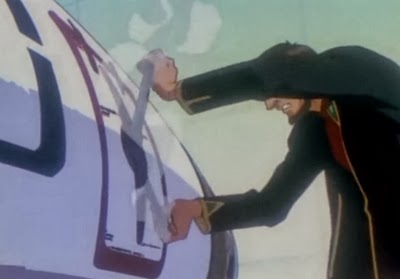
 Gendo Ikari saves Rei from being boiled in her entry plug
Shinji Ikari saves Rei from being boiled in her entry plug

Shinji's relationship with Kensuke and Toji: Kensuke Aida and Toji Suzuhara are two of Shinji's classmates, and the only people we'll really see become Shinji's friends throughout the bulk of the story. Kensuke, like Shinji, has no mother. Kensuke in some sort of idealised form of Shinji: we never see him showing any signs of insecurity or emotional weakness, and while Shinji's the frontman of a war he doesn't want to be a part of, Kensuke is a war-enthusiast, lamenting the fact that he doesn't get to be a part of the war.

Toji's first impressions of Shinji aren't all the flattering, unless you consider a heavy fist or two in the face a nice way to say hello. Shinji's first Eva battle has left Toji's sister severely wounded, so when Toji finds out that Shinji was piloting Eva Unit 01, Toji's not impressed. Later, after Toji and Kensuke's lives are directly saved by Shinji in the Eva, Toji insists that Shinji punch him back. Shinji does it, but immediately regrets it, insisting that he's the one who deserves to be punched, not Toji. Symbolically, this conflict and attitude has huge ramifications in Acts 2 and 3, playing out on a much larger scale.

Shinji's daddy issues: We don't learn much about Gendo Ikari in the first act, even though he's constantly around giving orders. We get to see that he's gruff and unfriendly right off the bat, that he has a cold employer/employee relationship with Shinji (which has been inactive for 3 years before the story starts), and that Shinji hates him. In episodes 5 and 6, we see Gendo caring about Rei, and Rei, who normally expresses very little of anything, lighting up when he speaks to her. Shinji freaks out a bit at the sight of this. It isn't clear to me whether he's jealous of Rei attaining his father's affection, or of his father attaining Rei's affection, so just to be safe I'm going to say it's both.

Shinji's mamma issues: We don't learn much about Shinji's mum at this point in the story. In fact, I'm not even sure if she's mentioned. But she has a great substitute in Misato Katsuragi. And by great, I mean Shinji's quick appraisal upon seeing the inside of her apartment is: "Ice....snacks....and fifty gallons of beer! What kind of life does she lead?!" Misato functions as Shinji's guardian throughout the series, which is made creepy by a whole lot of awkward sexual humour between the two early on, which reverberates later on. The sexual tension seems to be dismantled a lot through Shinji being unimpressed with Misato's sloppy housekeeping.

What's up with all this awkward sexual stuff, anyway? The short answer is: Shinji's a young teenage boy. No, really, that's it. Well, I guess the assumption that most of the audience are also teenagers (or creepy old people who are into awkward teenage sexuality issues?), and feeding the audience fan service is a factor, too (a factor that's played up really blatantly, mind you), but the more I watch this series, the more I think that everything being sexualised early on is about Shinji working through his sexual frustrations and identity more than anything else. Or maybe that's just a more comfortable way for me to think about it than to watch it now and awkwardly look away and shake my head when Shinji walks in on a naked Rei or gets flustered when Misato's boobs are in his face.

Subtle.

The sexual stuff goes deeper than awkward humour, though. The Third Angel (which is the first enemy of the series) is symbolic of Shinji's relationship with womankind. In particular, it's symbolic of when that relationship is damaged. Eva Unit 01 rips out one of the angel's ribs and uses that rib as a weapon, referencing woman being made of man's rib in the Bible. The angel, realising that it's going to die, decides that if it has to die, it may as well take down the Eva and everything else with it, indicating the messy crap that tends to happen during a break-up.

In turn, the Fourth Angel represents Shinji's estranged relationship with malekind. I almost don't want to write this, because I was able to go so long without seeing it, and once it's been seen, it can't be unseen. For years I was able to look at the Fourth Angel and just see a giant, buggy worm. And I like it that way. I want it to go back to that way. But again, what has been seen cannot be unseen. The Fourth Angel is a giant penis.

It's even got the...and the....and the way it...

Well, I'm overdue for sleep now. I'll continue this with Acts 2 and 3 once I've had some more sleep, and actually have the time to write. I'd say goodnight, but after seeing a penis like that...

Wednesday, November 13, 2013

Literature in the Classroom Appendages

Okay, I couldn't resist posting this up. This is one of the originals I worked from: Ania Walwicz's fairytale. Enjoy the most lovely story you'll ever read. The grammar is only my third-favourite part.

<><><>

once upon a time there was a king he had three daughters one was very pretty but the others why they were ugly as hell so he preferred the ugly ones because they were smart they were very clever indeed he said to them don't worry about getting husbands i mean all right if you want i'll arrange that no problems but you should think about studying first the beautiful one was dumb you see so he didn't like her at all not at all why don't you like me or something she asked him sorry i don't like you because you are stupid so she cried then this fairy heard her and felt sorry for her she better be sent to remedial classes or something the fairy said so she was to help her improve her spelling and stop paying attention to how she looked and all that so all the sisters were all right with the king after that and all getting good marks and scholarships to university because that's very important but the ugly ones started to worry about just how ugly they were so the king arranged for them to have plastic surgery so they looked a lot better after that and were all all right i think but then they wanted to get married after they got their doctorates only after that so that was a problem because they didn't meet many men because they were too busy at their study so the king had to think about what to do because they were driving him crazy all the time talking about getting married and worrying about being old maids so he advertised to the aristocratic gazette for handsome princes to apply so they did but the princesses didn't like them you see they were much too smart for these princes and laughed at them and so forth so that was worrying the king who was getting old by then you see he married late so by that time he was in his eighties and maybe would die he wanted to see his daughters settled so this time he advertised for very clever princes and they came but the princesses found them too ugly and said these men are very good to talk to but as far as looks are concerned forget it wouldn't touch them with a ten foot pole and the thought of kissing them just makes us sick well that was a problem what to do now what was the king supposed to do what were the princesses supposed to do and what were the poor unfortunate rejected princes supposed to do the king suggested maybe you could marry two princes apiece a good looking one for sleeping with and a clever one to talk to but that wasn't such a good idea so the princesses thought we got to think of something to do after all we got doctorates and they decided to produce perfect men for themselves the kind that would cook and be polite and wash dishes and be willing and able to tell good stories and the kind that wouldn't annoy them so they set out in the laboratory to combine all the parts of various princes to make good husbands and they worked all night but they didn't mind you see they enjoyed their work and were used to using their heads so lo and behold they made these perfect husbands by sticking all the pieces of various princes together if one had good eyes then they took his eyes too bad for him they had to do it and that was that and some prince would wake up blind too bad they said or take some prince's legs if they were nice legs they took them they would take them by special force of their minds and they took them and these men would wake up sometimes dead but it was all right for the princesses they didn't mind so they took what they liked and took brains and eyes and legs and shoulders and took hair and took feet a lot of princes died as a result and everybody thought that there was a plague and in the end the princesses had their husbands but they got bored with them and killed them because they enjoyed working in the laboratory more than marriage

Literature in the Classroom Assignments: Part 6

Foreword
Above is Paperman, a short animated movie void of any script. In my final experiment, I wrote a sequel, and to contrast the lack of script in Paperman, I wrote Sans Paper void of any script. In an unusual twist, I decided not to engage with the dark side, and actually try and write something kind of nice. I think my main motivation to do that was to actually challenge the views that get my so riled up in Boy, rather than to just repeat those views.

Sans Paper

Her: “Oh, you’re here early. I wasn’t prepared.”

Him: “Yeah...sorry about that.”

Her: “Aw, don’t apologise. Come here. Mmm...”

Him: “Huh...I could get used to a greeting like that.”

Her: “Well, come on. I haven’t finished cleaning up, so the place is a bit messy.”

Him: “Oh, no, not at all. Actually, it looks great in here...ahem...like...you...?”

Her: “Haha...oh, that’s so cheesy. Here, let me show you around. Oh, just take your shoes off – Taylor gets pretty uptight about that.”

Him: “Oh, sorry.”

Her: “You don’t have to keep apologising, it’s okay.”

Him: “I’m sorry.”

Her: “Hehe. So, this is the living room. We do living in it.”

Him: “That’s a beautiful painting. How’d you come by it?”

Her: “It was a housewarming present from my parents. I asked how they got it and a very long, boring story followed. After a half hour monologue...monologue? Dialogue? They were both speaking. I wasn’t speaking. Anyway, after a half hour somethingalogue, I think the conclusion was that they bought it at the shops.”

Him: “Wow, that is exciting!”

Her: “Riveting! Here’s the kitchen. We kitch in it. Bathroom’s down there.”

Him: “Whatever you’ve got cooking smells amazing. Mmm, I smell garlic...rosemary...and definitely some kind of roast. Beef?”

Together: “Lamb.”

Him: “So...

Together: “...you had some news?”

Her: “Oh, awkward turtle.”

Together: “You go—

Him: “Mmm-no-no-no-no-no. We’re not doing that cliché.”

Her: “Okay then. I’ll go. So...I got the job.”

Him: “That’s great!”

Her: “Thankyou. After that third interview, I really wasn’t sure I’d get it. The interviewer seemed really cold. But I’m so glad they accepted me.”

Him: “The third interview...that’s the one when I was...heh...trying to paper plane you?”

Her: “Mmm, that one.”

Him: “When do you start?”

Her: “Four weeks from now. That gives me plenty of time to hand in my notice at work. Oooh, I’m so looking forward to it!”

Him: “That’s really great. I’m so happy for you.”

Her: “Uh—urgh, you’re crushing me!”

Him: “Oh, sorry. I didn’t mean to...hm.”

Her: “You...don’t look very happy.”

Him: “...I just...I hope I’ll have news like yours soon. Very soon.”

Her: “I didn’t know you were looking to change jobs.”

Him: “Well, I wasn’t looking, but...apparently – who knew? – throwing all your paperwork out the window and abandoning work halfway through the day is a career-limiting move.”

Her: “O, oh...aww, come here.”

Him: “I don’t know what I’m going to do.”

Her: “Hey, there are plenty of jobs out there. You’ll be fine.”

Him: “That’s comforting, but I don’t think the world works that easily.”

Her: “You know what? This isn’t the end. This is the beginning of a new story. You told me that you wished for something more meaningful than stamping paperwork. This is your chance to do that.”

Him: “Do what?”

Her: “Change directions. Those paper planes led you to me. I think, maybe, they’re leading you to wherever you need to go. And wherever that is, it’s not where you were two weeks ago. Let’s make one more paper plane and throw it out the window. Wherever it lands, that’s your new job.”

Reflection of Sans Paper

Paperman is a short film without script. Inspired by it, Sans Paper is a short story featuring only script. Using only the characters’ spoken words produces significant gaps and silences, challenging the reader to use intertextuality to fill in the missing information. Likewise, as the writer I found it particularly challenging to allude towards certain actions and scenery without overtly describing it. By developing stories that highlight the gaps and silences, students learn how to evoke meaning through minimalistic language while gaining awareness of their own reading practices and use of intertextuality.

Sans Paper is a continuation set shortly after Paperman. While Paperman provides representation for two people meeting under paranormal circumstances, Sans Paper provides representation of the possible ramifications of the two meeting and beginning to know each other. Experimenting with continuations prompts students to think outside the box. In fiction, stories traditionally have a beginning, middle and end, however by practicing continuations students are encouraged to consider how people are affected beyond the immediate circumstance, which may help them to be mindful of their own decisions.

Contrary to popular gender roles in which the male is the hero and the female needs saving, in Sans Paper I have positioned the female as successful and able to help. Meanwhile, the male, as a direct result of his actions in Paperman, has recently lost his means for living and is in need of the female’s help. Instead of reinforcing a paradigm in which women are dependent on men without men depending on women, challenging gender roles in this way gives students insight into a world of interdependence.


Bibliography
Chiang, C. (writer), Hoyer, K. (writer), Kahrs, J. (director), Lasseta, J. (producer) & Reed, K. (producer). (2012). Paperman [Short movie]. Burbank, USA: Walt Disney Animation Studios.
Kincaid, J. (1992). Girl, (para. 1). In J. Kincaid, At the bottom of the river. New York: Plume.
Walwicz, A. (1985). Fairytale (para. 1). In S. Hawthorne (Ed.), Difference: writing by women. Australia: Waterloo.


Baur, L., Holmes, J. & Warren, P. (2006). Do men and women speak differently? Language Matters. Pp 146-156. Basingstoke: Palgrave Macmillan.
Moon, B. (2001). Literary terms: A practical glossary (2nd ed.). Western Australia: P K Print.

Literature in the Classroom Assignments: Part 5

Foreword

In an old OSH (outside school hours) club room, I remember reading a list of...I don't know, it kind of blurred between rules and hollow affirmations for the children. At #3 on the list, it said: "You are a good person no matter what anyone says." I've written before about what I generally make of people who announce that they're good, giving my experience that such claims tend to come from people who are simply judging themselves against the evil that they don't count against themselves.

I've noticed that people can do some pretty horrible things, and even better we're really talented at hedging our stories in such a way that the horror of our horrible deeds just doesn't seem so horrible. At our best, we not only hedge away the impact of how horrible we are, but we actually make it sound like our horrible deeds are a good thing, justifying that the things that make us evil can't be held against us, and should even be glorified.

In other news, I enjoyed doing the thing that feminists generally abhor, which is to deliberately reproduce gender differences. Overtly stating this in my reflection, surprisingly, did not appear to cost me any marks from my lecturer, who is a feminist. Really thought I was going to rustle some jimmies, there.

Dear Diary,

Today finally came. For the last three months I’ve been telling myself that I’m excited, but secretly, this whole time I’ve been terrified. What if my sisters were right, that I’ve got no brains? What if the other girls hate me or laugh at me for being stupid? What if the lecturers won’t take me seriously? What if I make it through university and dad still doesn’t think I’m good enough? Dad, I’m only doing this for you – I don’t even get why it’s such a big deal! Why won’t you love me? What if you’ll never love me?

Today finally came. Now that it’s here, I don’t know whether to feel honoured or sick. I suppose I feel a bit of both. My sisters have never respected me, but now I think they’re actually jealous of me. Last month I caught them stealing my makeup and trying it on. I’ll spare you the details on how badly that worked out for them, but suffice it to say it would be polite to suggest that they looked like clowns. Oh dear. Anyway, so, today I caught them begging dad to get them plastic surgery. Why? To look more like me. Me! A big part of me is thrilled, but I’m also kind of horrified. Hehe.

Today finally came. All my friends have been dating since, like, forever, but here I am, 23, and coming home from my first date. I don’t know...after all the hype my friends have made about boys, I guess I was expecting something...better? I mean, wow, he was hot. But then...urgh!!! He opened his mouth and it all went downhill from there! Dad, I think I finally get what the big deal is. I have a friend who’s dating this guy who...he’s nice, but, I’m sorry, he’s not nice to look at. She says that the more she knows him, the more attractive he becomes. Maybe there’s something to this...

Today finally came. Smart guys, dumb guys, sensitive guys, jerks, fat guys, fit guys: I’ve had my share of first dates with them all. Guys, what is wrong with you? My sisters and I have been looking for someone to marry, but no matter who we meet he’s just so flawed. But now we’ve had a Eureka moment: if we can’t find the right guy, why not make the right guy? After all, we are beautiful, educated women, and we deserve handsome, intelligent men. Is that really asking too much?

Today finally came. Today I married the perfect man. He has the perfect body and the perfect mind. He’s perfect in every way, and so he should be – after all I did take the best parts to make him. It’s a good thing there are so many men around – on their own they’re not very good, but their pieces are great! I know he’ll always love and cherish me. And as dad walked me down the aisle, I finally knew that he loved me, too. I can’t wait for my beautiful future with my perfect husband.

Today finally came. My husband was so boring! So...I think it was just time to realise that I deserve better. Oh well. I’m so excited to see what I come up with next!


Reflection of Dear Diary,

Dear Diary, is an experiment based on Ania Walwicz’s fairytale. Fairytale is written without any punctuation and in third person limited narrative. The combination of these elements resulted in me taking a very distant, impersonal reading of the original text. This is fitting, as the characters in fairytale do not appear to value individuality in themselves or others. In Dear Diary, I chose to focus on the naturally pretty princess from fairytale by recreating the story in first person through her eyes. Rewriting a story from a different perspective challenges students to consider the varying motives and concerns of others, which may help students to engage with people they would not normally identify with.

By casting Dear Diary, as a first person narrative, I took an impersonal story and made it very personal. This allowed me to foreground the princess’s hypocritical pursuit of perfection and acceptance. By highlighting this pursuit and having her casually reject others, I have privileged her undue sense of moral supremacy and silenced any voices in the story that might challenge her morals. Through deliberately privileging and silencing certain voices in textual experiments, students develop awareness of how they may be positioned disingenuously in various contexts, and can therefore respond critically to misleading information.

As a male, I encountered certain difficulties in writing from a feminine perspective. According to Baur, Holmes and Warren (2006), feminised language tends to use hedging words to soften the impact of the language. I have worked this into the text with phrases such as “I suppose,” “kind of” and “maybe.” Reinforcing imbalanced gender attitudes, I had the narrator describe herself as “educated” and the ideal man as “intelligent,” hinting at a gendered divide between acquired (or even imposed) knowledge and innate ability. Encouraging students to identify how they modify language in relation to gender enables students to reflect upon and challenge their presuppositions about gender.


<><><>

Now that you've read Dear Diary, check out fairytale.

Literature in the Classroom Assignments: Part 4

Foreword

Here's the first part of the second assignment. While the first assignment just had as giving reflections on pieces we'd looked at in class, the second assignment had as doing experiments of pieces from class. By experiment, I mean we had to take the original and fiddle with it in some way. Examples of our options included fan fiction, prequel, sequel, cross-over, retelling the story from a different perspective, using the style to tell a different story, making a script out of it, putting the character/s in a different setting, making a comic strip, etc.

During this first piece, you'll discover that I do in fact say harsher words than "poop," and am not opposed to using them in an assignment. Because I'm sweet and innocent like that. I got really emotional while writing this, and continue to get really emotional while reading it, which, apparently, means I'm a girl.


Boy
Eat your breakfast; brush your teeth; comb your hair; put on your uniform; tie your shoelaces – not that way, this way; take your lunch; class starts at 9:00, morning tea is from 10:45 to 11:15, lunch is from 1:00 to 1:50, school finishes at 3:00; be grateful – life only gets harder after this; do your homework; play with boys; you can play tag, ride your bike, pretend to fight (just don’t let me catch you or when your father gets home you’ll be in real trouble) or use a console; girls are nice so be nice to girls; don’t swear in front of adults; don’t swear in front of teachers; don’t swear in front of girls; if you teach other children to swear you’ll be in real trouble when your father gets home; listen to your teacher in school; listen to your teacher in Sunday school; boy, she sure is pretty; don’t admit that – what, do you want people to think you’re a girl?; don’t be soft; don’t cry; you need to be strong; you need to be tough; this is how you make friends; this is how you get respect; this is how you get power (and boy do you need power); this is how you throw a punch – no, not like that, what are you, a girl?; this is how you take a punch; this is how you dodge a punch; this is how you hit a ball; this is how you catch a ball; don’t drop the ball; don’t be so clumsy; this is how you cut your steak; this is how you chew your vegetables; this food is “junk,” and by junk I mean “treasure”; ignore what they told you in Sunday school – a man doesn’t need God to tell him how to live or repress him; this is how to ask a girl out; this is how to kiss a girl on the lips; this is how to kiss a girl on not the lips; this is how to make a girl kiss you; take your lunch; boy, she sure is hot; that’s more like it; don’t be emotional – you’ve got to be strong and you’ve got to be tough; girls are emotional, men are logical; is that what logic is? are you sure you understand logic?; work hard; work hard; you’ve got to work hard!; women only want men with lots of money; women only want men with impressive careers; women only want men who are tall, dark and handsome; lie to women – do you really think they’ll like you otherwise?; fuck women – fuck lots of women and don’t forget to fuck them over, after all they don’t want you, they only want your money and your status; nice guys finish last; don’t be nice, being nice is weak; this is how to fight your way to the top; this is how fight down those beneath you; this is how to fuck a woman; this is how to love a woman; this is how to fight a woman; this is how to provide for a woman; this is how to get a woman to love you; to love me? she sure is something, but I bet she isn’t even nice enough to give me food or comfort or...; haven’t I told you to take your lunch?

Reflection of Boy

Boy follows the structural style of Girl by Jamaica Kincaid. The diction is generally simple and the instructions are clustered into short phrases in order to make the long, run-on sentence accessible so that the overarching themes would be clear to the reader. The simple vocabulary conveys the central character of a boy internalising the social pressure to adhere to certain male gender roles. Just as Kincaid presents an oppositional discourse in relation to hegemonic femininity in her culture, my central aim in writing Boy is to provide an opposition to what I feel is the hegemonic masculinity on offer to white Australian youth.

Boy is littered with binary oppositions (“be nice to girls” vs “fuck women;” “listen” vs “ignore;” “this is how” vs “don’t;” “junk” vs “treasure”) which occasionally give the character clarification on how to live, but at other times provide only confusion and frustration over what it means to be masculine. By listing the traits of their gender identity, and of the gender identity they feel they’re ‘supposed’ to have, students can gain insight into their worldview. This allows them to identify and challenge harmful or contradictory beliefs.

The phrase “take your lunch” is used repeatedly throughout the text. Through polysemy, the meaning changes each time, beginning as a caring, harmless instruction, but later taking on sexual meaning. In the final use of this phrase, “take” is used in binary opposition to “give,” confirming the social pressure for the boy to prove his masculinity through selfish ambition and treating others as things to lord over. Tasks that encourage students to use polysemous writing would help students to grasp nuance and navigate context in their reading and writing practices.

Literature in the Classroom Assignments: Part 3

Foreword:

This was one of those short stories where I'm not sure you'd actually call it a short story. I seldom read anything with split narration. Even rarer is a piece like this in which the split narration is divided between a consistently inconsistent narrator and a very beaurocratic type who has nothing better to do than to point out the problems with the consistently inconsistent narrative. Glenda Adams, y u do dis?

Reflection: “Reconstruction of an Event” by Glenda Adams

If you desire to read a conventional narrative, Reconstruction of an Event by Glenda Adams is not the text for you. A key element that may cause frustration is the presence of two voices narrating the text. Several interpretations of the voices in the text were offered in class as we discussed ROAE. One suggestion was that both voices are the author: the first voice is her narrating the event; the second voice is her censoring herself. Another suggestion was that the first voice is the daughter retelling the event to an authority (such as the police), and the second voice is the authority figure opposing her claims. My initial reading, influenced by an academic background in creative arts and critiquing creative works, was that the two voices represented a student author and a harsh teacher or editor. In this regard, I interpreted ROAE as a metafiction (Orlowski, 1996).

Between the two voices of the text there is a clear power relationship. The first voice always submits to the correctional authority of the second voice. This is not necessarily a concern in itself, as the voice in power may represent a legitimate authority. What does concern me is how I initially inferred the identity of each role based on power and gender stereotypes. The first voice is obedient, emotive and prefers to use enriching language to bring life to the story. The obedience and emotive focus of the first voice resonated with my socially constructed views of youth. I inferred the focus on the daughter and enrichment as signs of femininity (Cameron, 2005). The second voice is authoritative, objective and insists on purging any enriching language. The second voice attempts to remove life from the story. Because of this, based on socially constructed assumptions about power and authority, I’m inclined to read the second voice as older and masculine (Cameron, 2005). The most frustrating issue I encountered with the second voice is that it never gives positive feedback. Even after the final reconstruction, the second voice replies with a cold: “No.” The second voice consistently objects to anything other than the facts, which makes it ironic that none of my inferences about gender allude to any objective truth about the text. Objectively, the voices are anonymous.

After multiple readings, I started to recognise the jacaranda as a symbol of life, joy and safety (Moon, 2001). The jacaranda is introduced in the first paragraph, in which all is pleasant and there is no hint of danger: joy and safety. It is reintroduced in the tenth construction of the event in which, upon recognising danger inside the house, the mother takes the daughter outside and “leans her against the jacaranda tree”: safety. Finally, in the twelfth construction of the event, the father is taken out to the jacaranda tree where he revives: life.

While the use of suspense in ROAE was clear from my first reading, it took several readings before the use of foreshadowing became clear to me. Adams uses suspense effectively to turn thirteen lines of plain facts in the third-last paragraph into five pages of text (Moon, 2001). In my initial reading, every time the second voice opposed the first voice, I became curious about how the first voice would modify the story. Likewise, every time the first voice changed the story, I became curious about what oppositions the second voice would give. Because each construction of the event contradicts the previous construction, it took a full awareness of where the text was heading before I recognised the clues throughout the text. In the third construction, the father is introduced as a man of unrest, whose daughter is “driving him into an untimely grave” by going out at night. In his only lines of speech, he declares: “They will rue the day...and they will all be sorry when I’m gone.” In my initial reading, I took this as lightly as the family are said to take it. This may be due to personal acculturation into a society in which the Dominant Discourse sees stress in middle-age, middle-class fathers as normal and trivial (Gee, 1991). In the final construction, it is revealed that the father has committed suicide, and the daughter seemingly feels guilt for going out and later ignoring the signs of unusual behaviour the night before.

ROAE could be used in the classroom to generate discussion about how different writing techniques influence reading. Despite this, I believe it could serve more profoundly as a tool for investigating deeper social issues. Specifically, this text can open up discussions about students’ assumptions about gender and power. Sensitivity should be given to students who feel responsible for issues affecting their families, as this text alludes to the daughter’s sense of guilt without challenging or dealing with her sense of guilt.


References
Cameron, D. (2005). Language, gender and sexuality. Current Issues and New Directions in Applied Linguistics. 26(4), 482-502.

Freebody, P. & A. Luke. (1990). Literacies programs: Debates and demands in cultural context. Prospect: An Australian Journal of TESOL, 5(3), 7-16. Retrieved 2013, from http://eprints.qut.edu.au/49099

Gee, J.P. (1991). What is literacy? Rewriting Literacy: Culture and the Discourse of the Other. 3-11. Westport, Conneticut; London: Bergin and Garvey.

Luke, A. & K. Dooley. (2010). Critical literacy and second language learning. In E. Hinkel (Ed.). Handbook of Research in Second Language Learning and Teaching. Vol 2. London: Routledge.

Moon, B. (2001). Literary terms: A practical glossary (2nd ed.). Western Australia: P K Print.

Orlowski, V. (1996). Metafiction. Retrieved September 19, 2013, from http://postcolonialstudies.emory.edu/metafiction/


Adams, G. (1979). Reconstruction of an event. In G. Adams (Ed.), The Hottest Night of the Century, (pp.121 - 125). London: Angus and Robertson.

Adams, G. (1987). A snake down under. In W. Morgan (Ed.), Border Territory: An Anthology of Unorthodox Australian Writing, (pp. 102-104). Melbourne: Thomas Nelson.

Dove. (2013, April 14). Dove real beauty sketches [Video file]. Retrieved from http://www.youtube.com/watch?v=XpaOjMXyJGk

Literature in the Classroom Assignments: Part 2

Foreword

In Australia, we have snakes. And private schools. And private school girls. And horny private school girls. And horny private school girls who get bitten by snakes.

Now get your head out of the gutter.

Just kidding, turns out the gutter's a great place to be when reading this one.


Reflection: “A Snake Down Under” by Glenda Adams

In my first reading of this text, I made a point of not acknowledging the sexual innuendo in the title A Snake Down Under. Consequently, I initially read ASDU by Glenda Adams as a disjointed short story about protection from dangerous wildlife mixed with religion-induced sexual tension, linked only by the witty final sentence: “My friend said, ‘Did it offer you an apple?’” As I explored the text in class, group discussions pushed me to recognise the double entendre in the title and thus recognise darker sexual themes perforating throughout the whole story.

In ASDU, Adams uses polysemy and symbolism to superficially tell one story, while telling a much more sinister story beneath that guise (Moon, 2001). While a snake is literally a legless reptile, in the sense of this text I took the word snake to also mean (at varying times) phallus, temptation, sin, predator, dangerous man and sexual violation. Teachers may also be symbolic of the conventional wisdom of the Dominant Discourse (Gee, 1991). By reading these double-meanings into the narrative, my interpretation of each snake-related event changed drastically. For example, in the middle of the story a girl sits on a snake which bites her. She doesn’t tell anyone until it’s too late, and then she dies from the snake’s venom. Unlike other scenarios in the text where snakes approach girls, in this instance the girl goes to the snake, which (assuming that the snake is a sexual predator) suggests to me that she has been abused by someone she should have been able to trust. In isolation, I suspected that the snake may a family member. However, given the frequent religious references (in the setting of an Anglican school) and the introduction of a preacher later in ASDU, I think there’s sufficient textual evidence to suggest that the perpetrator is a member of the school staff or the clergy.

As a Christian, a man and a pre-service teacher, I’m inclined to take a resistant reading to this text. ASDU presents Christianity as a source of arbitrary sexual repression, and possibly sexual violation. The teachers in the text, though perhaps well-meaning, teach the girls to respond to sexual abuse passively, and in doing so enable abuse. Likewise, males are generally regarded as snakes and are never positioned in a positive light. My resistance is perhaps amplified by living in a culture where abuse in the church is a hot topic; religion is seen as arbitrary; teacher-student sex scandals frequent the news; and a man can’t photograph his children without being suspected of paedophilia. Christianity and masculinity gain no positive representation in the text, and teachers are at best misguided. From this I infer that the author is seeking to vilify religion, men (or a socially accepted form of masculinity) (Cameron, 2005), teachers, and perhaps society as a whole. Despite my inclination towards resistance, I must concede that there is truth in these aspects of the text. While many Christians, men and teachers hate sexual abuse and aspire to protect people from becoming victims, there certainly are Christians, men and teachers who commit or enable sexual abuse.

It would be foolish to recognise negativity in Adams’ assessment of those whom she represents as snakes without also recognising the way she challenges femininity. It appears to me that Adams agrees with the position that gender is a social construct (Cameron, 2005), unlike sex which is biological categorisation. From this position, I interpret her representation of conventional femininity to be resistant. ASDU shows how girls can be acculturated into behaving like silent, motionless automatons to their own detriment. The text also shows the narrator “br[eaking] the rules” by being loud, violent and unrestrained in the face of danger, which results in the snake leaving her unscathed.

In my eyes, the two most potent elements of ASDU are the literary use of allegory through polysemy and symbolism; and resistance to social constructs. By critically analysing the polysemic structure of the text, students may learn the significance of hidden meanings in texts. Students will therefore be better equipped to identify and challenge both superficial and deep elements of a broad variety of texts. Likewise, by critically analysing Adams’ representations of religious institutions, educational institutions, masculinity, femininity, ethnicity and society as a system, students may learn to question the social constructs that they take for granted and consider alternative ways of being.

Literature in the Classroom Assignment: Part 1

Foreword

Before I turned this into an assignment, I was actually going to blog about it here, a few months back when we looked at the Dove Real Beauty Sketches video in class. The desire to blog and rant about it was sufficient incentive for me to do an assignment on it, and then when I was done I wanted to share it here anyway. Now that the unit is thoroughly complete, I'll be posting this reflection, as well as the other reflections and writing experiments I did across my two Literature in the Classroom assignments. These pieces have not been edited in any way since submission, so anything my lecturer found objectionable or thought was poorly written (actually fairly little, considering I got a 6+ for each assignment), you can find objectionable, too.

Here's a link to the video for Dove Real Beauty Sketches. Watch it first, then read on:


Cliff's notes on what I had to say:
from the first draft (not the version I ended up submitting below): "After having some time for my thoughts to percolate, I believe I expressed my new interpretation of the text with sufficient strength during a group discussion in class by announcing: 'I want to punch this ad in the face!'"


Reflection: “Dove Real Beauty Sketches” by Dove

As a white, semi-middle class male in Australia, I’ve been conditioned to accept it as a universal truth that females are insecure about the way they look, to the extent that they hate their bodies. This, of course, is not universally true, however the incidence is enough that as a high school teacher I can expect to have female students and even work alongside female teachers who suffer from body image issues. Consequently, the first time I saw Dove Real Beauty Sketches, I was inspired and encouraged by seeing a campaign with the apparent aim of improving female body image. Alas, this elation was fleeting.

Superficially, DRBS is effective in its use of binary oppositions to make an overt statement about beauty (Moon, 2001). Each subject describes herself to the sketch artist in what she and the audience) perceives to be a negative way (this, in itself, warrants deeper considerations as to whether or not the descriptions given should be regarded as negative), which is juxtaposed by a second person describing the same woman in a positive light. At the end of the video, the two sketches of each woman are presented side by side in opposition to each other. Invariably, the second sketch appears more appealing to the women in the video and is described positively by each subject.

When I took a step back and considered the advertisement from a different perspective, my affections towards DRBS were replaced with an aggressive distain. As a text analyst, instead of focusing on DRBS as a solution, I considered the cause of the problem (Freebody & Luke, 1990). Having experienced serious body image issues in my own life with symptoms that match body dysmorphic disorder, it has been my experience that body image issues are frequently caused by the acceptance of the belief that beauty is a source of merit. Just as intellectual, moral and financial success are all measures used in my culture to judge oneanother, beauty is used in my culture to judge oneanother, and it is something which we can think of in terms of success and failure. While DRBS challenges the severity with which women stereotypically judge their beauty, it fails to challenge the fact that these same women do judge their beauty. More profoundly, it fails to challenge the issue of women judging their value and success as humans by their perceived beauty. Because it fails to address the deeper psychosocial issues at play, I believe the text is no more equipped to support women’s confidence than a band-aid is equipped to deal with a cleft artery.

While the video was potent in my initial white, affluent Australian Discourse, the video became impotent in my Christian Discourse (Gee, 1991). Just as I was challenged to evaluate the values taken for granted by the text, as a Christian I was also challenged to evaluate what personal values I was applying to the text in order to have my initial response. I realised that I, too, was taking for granted the belief that it is normal and acceptable for women to judge their individual worth based on perceived beauty. This is inconsistent with the very worldview that I claim to uphold. The Bible rejects the worldview that an individual’s value can be measured by how successful they are. Whether social, financial, business, familial, moral, ritual or beauty, these culturally accepted grounds for personal value simply do not apply under biblical theology. Instead, a person’s value is grounded in them being one of God’s creations, made in God’s image, for whom God has laid down His life. For the follower of Jesus, Christ is the most important thing. For DRBS, perceived beauty is the most important thing.

Placing DRBS in a classroom context produces its own challenges. Since this text reinforces idolisation of beauty, I don’t think it would work as a text used to challenge girls and boys over their attitudes towards beauty. However, it does serve a valuable role in helping children learn to decode and challenge persuasive texts. The use of binary opposition between negative and positive is a powerful rhetorical tool which, in this instance, is used to privilege one view and marginalise another. An awareness of this would help students to critically analyse a variety of texts.

Tuesday, October 22, 2013

What You Say/What I Hear

What you say:
I'll try anything once.

What I hear:
I'm lying to sound super adventurous so that you'll like me.
My imagination is very lacking, and I haven't really considered what "anything" might entail.
I really will try anything once, therefore it's amazing that I haven't gotten myself and/or others killed yet. Hey, is that a toaster I can stick this knife into?

What you say:
I hear what you're saying.

What I hear:
...and what you're saying is wrong.

What you say:
I'd really say I'm much more logical than emotional.

What I hear:
I'm deeply emotionally dependent on the belief that I'm logical rather than emotional.
There's a 95+% chance that I have no idea what logic is and can't tell a logical argument from a logical fallacy.

What you say:
Be reasonable!

What I hear:
Be emotional!
Agree with me! 

What you say:
If people were just better educated, this problem wouldn't exist.

What I hear:
I wasn't really listening when they told me you can lead a horse to water but you can't make it drink.

Sunday, September 15, 2013

Trying to Earn Heaven = Cosmic Regifting

Thank God for children. This morning while I was helping out with Kids Biz, one of the boys mentioned that "You can't bribe God." These words are not new to me, but something clicked in that moment and the meaning of that statement hit me deeply.

I've been thinking lately about what makes a human valuable. In meritocracy, you might argue that someone's value as a human being comes either from their success, or from their potential for success. This could be in any area: strength and fitness (seems relevant to this blog); intelligence; academia; finances; business; family; seduction. However, from a Christian framework, a human's value comes from being a creation of God made in His image, and this value is demonstrated by God laying down His life for humans as we lack merit.

How does this relate to our inability to bribe God? Well, if we're made in God's image, then anything we could possibly offer Him that might in itself be pleasing to Him is something He has given us already. Any love we may offer Him is love that He gave us first by making us in His image. Any love we may give to our neighbours is love that He gave us first by making us in His image. We have no power but the power God has given us. We cannot give Him anything good that wasn't His to begin with.

And so if it were possible for you earn paradise, it could only be because God made you innately worthy of paradise, in which case there would be nothing to earn. And as we do not have any innate power to be Godly, we do not have the ability to make ourselves worthy of paradise. What can we possibly offer God that wasn't given by Him to us in the first place?

Saturday, September 14, 2013

The Terminator: Do You Even Time?

There's something that's always itched at the back of my mind when I think about the Terminator movies, and it's the inconsistent model of time.

In the original Terminator movie, we have time travel working in a circular model. The future, for obvious reasons, is dependent on the present, but the present is also dependent on the future. When Kyle Reece and the Terminator come back to 1984, they don't change time, because the timeline they both come from is a timeline that could only exist if Kyle Reece and the Terminator went back to 1984. Without them both going back to 1984, John Connor would not have been born and then raised up to become the leader of the humans, who would later defeat the machines, prompting the machines to send back a Terminator (and the humans to send back Kyle Reece) to 1984. It's a neat, internally consistent system.


Then the sequels happened.

In T2, we discover that the presence of the Terminator in 1984 left technology that was the basis for research that would later develop into Skynet. In other words, the Terminators exist in the future because a Terminator (from the future) existed in the past. This feeds beautifully into the closed circular system of time established in T1. Then what happens? The heros come along and destroy the research that would later become Skynet and destroy all evidence of Terminators or Terminator technology, seemingly changing the future. Circular time is now broken, and an alternate timeline has been established.

Of course, then T3 happens, justifying that the rise of the machines has just been delayed, which I assume is 1) a weak grab at an excuse to cash in on a franchise, and/or 2) a sloppy set up to allow future Terminator movies. This also means that the R&D based on the remains of the original Terminator from 1984 is a red herring.

Now, in T1, the revelation that Kyle Reece is John Connor's father shows us that a future in which the humans win is dependent on a past with Kyle Reece in it. So then, if the machines can't kill John Connor directly or retroactively abort him by killing Sarah Connor before she gives birth to him (the mission from T1), a viable alternative is to prevent Kyle Reece from going back in time -- if they know that he's the father. In T4, this is exactly what they attempt to do, making a young Kyle Reece a target. The problem here is that if they know that Kyle Reece is an issue, and if that's the case, all they need to do to prevent John Connor from being born is to never use time travel technology.

Yep, it's that simple. If the machines don't send any Terminators back in time to try and get rid of John Connor, then Kyle Reece doesn't go back in time, therefore the machines succeed in removing John Connor from the equation and win the war. Now, if T2 hadn't ended with the humans destroying all the R&D and melting the two active Terminators, then we would have logical cause for the machines using time travel whilst knowing that Kyle Reece's existence is a problem for them: without using time travel, they wouldn't exist, so failure to use time travel is an instant complete and utter fail for them.

So, if I had a say in the making of the Terminator movies, I would not have the humans succeed in destroying the R&D in T2. Then the machines could rise up against mankind in T3 without some lame explanation for why that's still going ahead. We could go either way with Kyle Reece being targeted in T4 -- the machines don't have to know that he's John Connor's father, however they don't need to be ignorant of that fact, either, so long as they know that their existence is dependent on having sent back a Terminator to 1984.

There are other continuity and logic errors that show up throughout the series (eg why can the T1000 travel through time when he isn't living, organic flesh over metal, but is metal in the appearance of flesh? why send only one Terminator back to each point in time -- why not send multiple Terminators back to 1984 to finish the job of the original Terminator?), but that's what Cracked.com videos are for.


Tuesday, August 27, 2013

Not a Single Training Session Was Given That Day

So, it's now been 7 days since I've trained. Last training session, I noticed I felt a little less warm than usual, but figured that's just the weather, and thought nothing of it. Well, I got home afterwards, logged it, felt fine for the rest of the day, then evening came, and it took 4 more days after that before I stepped out the front door again. You know how you get a cold (different from simply being cold), and it starts out inconspicuously then ramps up to peak awfulness, then dies down and withers away to nothing? This isn't that.

Instead, by the end of last Tuesday, I was sick enough that I couldn't go out in public without resembling The Simpsons' crazy cat lady (actually, my symptoms weren't overly severe, they just happened to be specifically targeted to make sure I couldn't possibly do anything socially acceptable), and then my body just stayed that way. It didn't ramp up, and it didn't die down. Come yesterday morning, when I realised I still wasn't healthy and ready to train, I decided to do the sensible thing that macho men don't do, and see a doctor. I'm on antibiotics now; hopefully by the time I've used up the pack I'll be back to full health. I haven't decided whether I'll train throughout the remainder of the week or not yet -- I'll have to use my wisdom as the week progresses. The antibiotics do seem to be having an effect, so that's a positive sign (or a complete coincidence).

In other news, it's that time of semester when assignments happen, and I'm not particularly fond of it. One of my units is entirely group assignments. We had an assignment due in yesterday. Technically we submitted it late, by a matter of seconds (assignment minder literally clocked out as we were handing the assignment to the guy at reception, so he had to put a note on the assignment, and I wound up sending an email to the lecturer explaining the situation -- she was very considerate and said she'd regard the assignment as having been submitted on time). For about 3 days leading up to submitting it, each of us, at varying points, felt like killing ourselves, each other, and/or the lecturer for giving us this assignment. In a couple weeks time we have to do a presentation from this assignment. I look forward to the murder-suicidy thoughts that are coming our way. I have another assignment that's due this coming Friday. I started on it Sunday evening, and am cautiously optimistic that I finished it this afternoon, having put in a total of about 5 hours work (4 hours of which was spent watching YouTube (actually not proscaniting) and on Facebook/forums (actually yes procrastinating)). There's so little murder-suicide in this assignment, that after the other one, it doesn't feel right. Ironically, after lunch I sent an email to the lecturer for this assignment asking for an extension due to illness -- if my optimism is rightly placed and I have actually finished it, then I guess I won't need that extension after all.

So far, this semester at uni hasn't been very motivating. Back when I was studying creative industries, I loved it. Over the last 12 months, I've loved my teaching units. I love my English units. Last semester, when I was studying health, I loved that, too. This semester, I'm a year ahead on teaching units, so I'm not doing one, and instead am using that slot to do a second science unit after changing majors from English/Health to Science/English (in that order because of reasons) -- ie I'm doing 2 science, 2 English and 0 teaching units this semester. One of the science units looks not at a specific field of science, but how science and technology affects society (and how society affects science and technology), which brings up all sorts of controversy and ethical queries and I love it! The other science unit is biology, and through it I'm rapidly realising that while being a qualified science teacher may make it easier to get a job, I probably should have stuck with English and Health. You see, it turns out that I love science so long as I don't have to do it (the same relationship I have with maths, which I'm actually quite good at, but hated doing it at school and would very likely hate even more at uni). When we weren't plotting each other's murder yesterday, the other guy in that painful group assignment identified that we're both science enthusiasts, not scientists, and therein lies the problem for me. As a teacher, this doesn't bode well, because there's very little worse for a student than a teacher who either isn't passionate about the subject, or is only passionate when they don't have to do it. I might have to change my majors again before next year (I will finish out these units, even though I've sincerely had more fun watching paint dry than I have doing biology).

With regards to maths, I had a fun time on Saturday night. A friend of mine who's doing Adult Tertiary Prep (basically Year 11 and 12 for people who aren't in Year 11 or 12) gave me a maths problem to solve. I didn't solve it the way he thinks I should have solved it, but, importantly, I did solve it in about 2 minutes. By contrast, he spent half an hour on the exact same problem in a test earlier last week. It's times like these that he thinks he's found proof that I should be a maths teacher. Thing is, it's times like these that I don't have to do maths.

Wednesday, August 14, 2013

I Love Slow Results

All around us, fitness marketing offers fast results. Some of the extravagant claims I've heard or read have been: gain 10lb of muscle in 2 weeks; and lose 1kg per day. Mmmm, wouldn't that be nice.

Of course, reality is, those results don't happen. If you want to gain 10lb of muscle, you're looking at 6-12 months of training as a beginner, and even longer if you're advanced. That's not what anyone wants to hear, but it's the truth. Just imagine if you could gain that much muscle in 2 weeks -- you'd make Ronnie Coleman look like a sissy within a year!

Likewise, if you lose 1kg per day, it's fairly safe to say that you're losing a lot of fat-free mass. Since I assume you want to lose that weight to be less fat, I hope you'll understand why losing fat-free mass is a waste at best, and detrimental at worst.

When you compare reality to the market-driven attitude of "I want it all, and I want it yesterday," reality looks quite disappointing. But you know, the funny thing is, when you pursue reality instead of a fantasy, you actually get quicker, better results. Yes, you just read that correctly: Ryan is claiming that the pursuit of slow (ie realistic) results will get you better results than the pursuit of quick fixes. There are a few reasons for this.

1) If you try gaining weight too quickly in the pursuit of muscle, you pile on excess fat. This requires more time cutting fat later on, during which you will likely stop gaining muscle or even lose muscle.

2) If you try losing weight too quickly in the pursuit of fat loss, you will lose more than just fat.

3) Combine points 1 and 2 together, and after 6 months of bulking and 6 months of cutting, you're right back where you started, more or less.

4) If you understand that results will come slowly, and you expect this to be the case, you'll actually appreciate the results that you get. The person who drops 20kg in 6 weeks, still looks crappy in their own eyes, and then quits and returns back to their pre-transformation lifestyle will gain back the weight lost, and will often gain back more. The person who expects it to take a year for them to lose 20kg is more likely to appreciate it when they get halfway there after 6 months and can do their belt one or two notches tighter. When they lose the full 20kg, instead of thinking "I'm getting nowhere; this is pointless," they'll think "wow, I actually did it! This is amazing!"

5) Fast results are what you pursue when you want the end product but don't want what it takes to get the end product. Slow results are what you pursue when you know that this is a journey and a lifestyle transformation, not just a change in what stares back at you in the mirror. If you dedicate 6 weeks to losing 20kg, it's usually with the intention of returning to normal behaviour afterwards (when your normal behaviour is what's made you need to lose 20kg in the first place). If you dedicate 52 weeks to losing 20kg, the activities involved in the process will become a habit and lifestyle by the time you've lost 5kg.

There are probably other factors to consider as well. But the point is, the person who is committed to getting slow results will actually get real results, and is more likely to maintain those results and/or move on further along their fitness journey, whereas the person who pursues fast results is more likely to get fake results and quit once disillusionment settles in.

Saturday, July 20, 2013

Mid Year Camp and Some Exercise: Spiritual and Physical Training

So, I spent the last week, from Sunday afternoon to Friday afternoon, on MYC, a bible camp put together by AFES (Australian Fellowship of Evangelical Students). It was about 90% bible and 10% camp, making the first couple days feel more like bible college than camp, but I'm not complaining, even though it was mentally exhausting. On Wednesday, after a discussion on what it means to be a missionary (turns out you don't have to go to impoverished nations to bring food and the bible to be a missionary, turns out by definition all Christians are missionaries wherever we are) in the lobby area of the camp site, I picked up the lamo-brand barbell in the lobby, stuck some weights on the side and did supersets of OHP and BOR with about 40-45kg (based on the assumption that the bar was 5-10kg). Got a dirty look by one of the people running the camp site while I was at it. I wonder what sort of reaction I'd have gotten with jerks and Pendlay rows...

I played basketball one day. In our small teams, I was chosen for wearing a shirt that says: "I'm multi-talented: I can talk and annoy you at the same time." I guess the team leader didn't know that amongst my multiple talents, basketball, and indeed all ball sports, are nowhere to be found. I lost count of how many hoops the other team scored, but I distinctly recall my team scoring 0. There was a river walk at 7:15am on Thursday. I got up early for it, but also spent time beforehand making myself pretty by shaving, which resulted in me arriving at 7:20am, at which point whoever was going for the walk was gone. I ran to wherever I could see water from the dining hall, which meant about 20min of fasted cardio, but did not find any signs of human life. So I called it quits and opted for breakfast, over which I had a great deep and meaningful conversation, including a lot of edification and encouragement, and some effective kicking in the rear end. A few more deep and meanfinguls occurred in the latter half of the week, including staying up 2 hours after normal camp bed time with a small group macho-looking young men (eg one looks like a football player and probably is, one has a beard that every man is secretly envious of) talking about our dads. One of the guys started the night with a cup of coffee and ended the night with a cup of tears and snot, according to his own words. Much more enriching conversation than "So...what do you study?" Along the way, I got a look at some of the big blind spots that are ignored in my church communities, so now I get to be a man on a mission, and just as I've gotten a few good kicks in the butt on camp, I intend on giving a few good, swift kicks in the butt to my brothers in the near future. Action is good.

Even though I have a car of my own, I opted to get a lift from other campers to and from the site (my car's not great for bringing passengers and their luggage, and I have the geographic sensibilities of a carrot). The girl who drove me and a couple others from my church community home discovered that the added weight of people + luggage makes an uphill start a trickier game. Long story short, I was happy to give her whatever cash I had to go a tiny way towards helping with the costs of repairs to her vehicle.

This morning I went to the gym and did the most disgusting thing anyone's ever done: a conditioning session. Went away feeling all worked out and good in just under an hour. Despicable.

Skipping
About a minute or 2 of flailing about.

Sled Drag
100m x 20kg
100m x 30kg
Several sets (wasn't really counting; something like 6) x 50m x 40kg

Log Press/Cable Row
10x11kg/10x50kg
10x16kg/10x50kg
10x21kg/10x50kg
10x26kg/10x50kg
2x10x31kg/10x50kg

Body Weight Box Squats
5x5